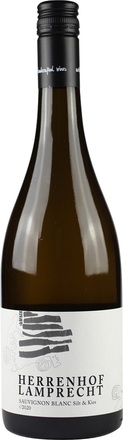
"Sauvignon for people who don’t really like Sauvignon all that much… a niche market granted, but you’re not going to find a wine that fills the gap much better than this. Gottfried does a sort of ‘Nouvelle Vague’ cover version on the grape… you recognise the song after a couple of lines but the emphasis is in very different places and the timing isn’t what you were expecting either. Bright and charming with a subtle smoky flinty note. Excellent with Grilled oysters with butter sauce."
The property at Herrenhof-Lamprecht used to farm cows, pigs and then apples before Gottfried Lamprecht took over from his father and created the winery on his family’s 9ha farm in Styria, southern Austria. The estate is sited around the perfect rolling hill of his Buchertberg® vineyard (yes it’s a registered trademark), littered with the prized opok soils, sloping southwards just outside the farmhouse.
Gottfried makes enthralling wines using an approach that many would call natural, but he would call “handcrafted”. Organics with some biodynamic practices, but he staunchly doesn't "believe in earth ghosts" or following Steiner's philosophies word for word. “I am a huge part of the terroir too. It’s there, but I don’t talk about it. It’s my vision” Gottfreid explains.
There’s edges and sparks across Gottfried’s wines, they’re so very much alive, and brimming with energy, yet manage to lean away from funk, and into concentration, structure, and a certain aristocratic grace and balance.
The winemaking is fairly simple. Most wines are destemmed and crushed. He avoids being overly phenolic, so there’s very little forced extraction or lengthy skin contact. Typical maceration is between 36-40 hours. All fermentation is spontaneous, he uses used 300L to 600L oak (40% coopered locally), and extended lees aging is key (9-18 months). The only addition is SO2 at bottling, usually around 20ppm total.
The winemaking is fairly simple. Most wines are destemmed and crushed. He avoids being overly phenolic, so there’s very little forced extraction or lengthy skin contact. Typical maceration is between 36-40 hours. All fermentation is spontaneous, he uses used 300L to 600L oak (40% coopered locally), and extended lees aging is key (9-18 months). The only addition is SO2 at bottling, usually around 20ppm total.
