
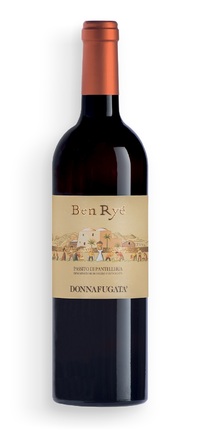
"Brilliant gold in colour with bright amber hues, the 2023 Ben Ryé offers an intense bouquet of dried grapes, apricot, peach, and candied orange peel, complemented by aromatic hints of Mediterranean herbs. On the palate, sweet notes of honey are layered with rich fruit and subtle balsamic nuances, leading to an intense and persistent finish of remarkable balance. 100% Zibibbo"
The Rallo family has made wine in Marsala since 1851 and their ancient cellars tunnel beneath the city. They were one of the first families to begin making high quality table wine when sales of traditional Marsala started to decline, launching the Donnafugata label in 1983 and championing the potential of the region's native varieties. Today, Donnafugata has four estates in Sicily: a modern winery and 283 hectares at Contessa Entellina in the hills east of Marsala; 36 hectares in Vittoria to the south eastern point of the island; 68 hectares on the island of Pantelleria; and 18 hectares on the slopes of Etna. Donnafugata means 'fleeing woman' and is a reference to Queen Maria Carolina, who escaped the court of Naples in the early 19th century with her husband, Ferdinand IV of Bourbon, when Napoleon's troops arrived. The couple took refuge in Sicily at the Santa Margherita Belice palace, also the favourite residence of celebrated writer Giuseppe Tomasi di Lampedusa and depicted on the 'Mille e una Notte' label.
Made from vines planted on the island of Pantelleria (southwestern Sicily), this is a modern take on the classic Moscato Passito. The name Ben Ryé derives from the Arabic 'Son of the Wind', after the wind which sweeps round the island. Vines are planted in hollows in the ground, at altitudes of 20-400 metres above sea level on terraced, sandy slopes of volcanic origin. The low bush vines of Pantelleria have been described on the UNESCO World Heritage List as a 'creative and sustainable practice'. The vines are over 100 years old and are ungrafted.
The 2023 vintage proved challenging, with heavy rainfall in May followed by a 10-day heatwave in July. Overall, the vineyards received over 100mm more rain than the island’s average. These conditions required careful pest control and canopy management throughout the growing season to maintain grape health. Despite lower yields, the smaller berries achieved full ripeness and remarkable concentration.
Grapes were hand-harvested and carefully selected in the vineyard. Upon arrival at the winery, they were sorted on a vibrating table and gently pressed. Fermentation took place in temperature-controlled stainless steel tanks. The dried grapes were destemmed and hand-selected before being added to the fermenting must in several stages. A post-fermentation maceration followed, during which the dried grapes imparted sweetness and aromatic complexity. The entire process lasted over a month. Ageing occurred in stainless steel tanks for five months, followed by a minimum of 16 months of bottle ageing before release.
